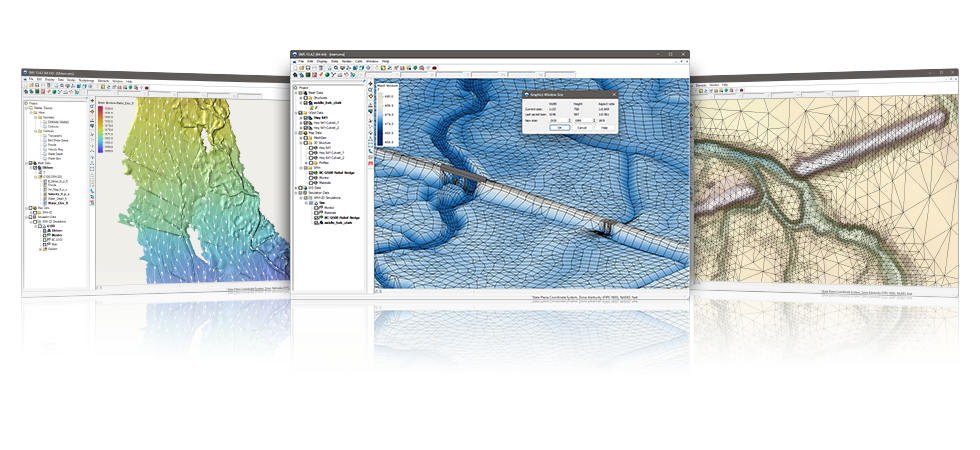
The Surface Water Modeling System (SMS) is a comprehensive environment for one- and two-dimensional models dealing with surface water applications. SMS models include support for hydrodynamic, advection/diffusion, sediment transport, waves, and particle tracking.
SMS can import data from a variety of files including text, CAD, and GIS files. SMS contains many visualizations options including contours (filled or linear), flow/velocity vectors, creation of animations, and exporting to Google Earth or GIS.
New enhancements and developments continue in cooperation with the U.S. Army Corps of Engineers Waterways Experiment Station (USACE-WES), and the US Federal Highway Administration (FHWA).

Automated Mesh/Grid Generation
SMS can be used to construct 2D finite element meshes and 2D finite difference grids of rivers, estuaries, bays, or wetland areas. The tools include a sophisticated set of creation and editing tools to handle complex modeling situations with relative ease. Several methods of finite element mesh creation are available, allowing you to create any combination of rectangular and triangular elements needed to represent your model domain. Cartesian grid creation tools are available to allow representation of a model domain for finite difference models.
There are two main methods for building models in SMS, the direct approach and the conceptual modeling approach. With the direct approach, the first step is to create a mesh or grid. The model parameters, source/sink data, and boundary conditions are assigned directly to the nodestrings, nodes, and elements of the mesh. This approach is only suited for very simple models.
The most efficient approach for building realistic, complex models is the conceptual model approach. With this approach, a conceptual model is created using GIS objects, including points, arcs, and polygons. The conceptual model is constructed independently of a mesh or grid. It is a high-level description of the site including geometric features such as channels and banks, the boundary of the domain to be modeled, flow rates and water surface elevations of boundary conditions, and material zones with material properties such as Manning's n value. Once the conceptual model is complete, a mesh or grid network is automatically constructed to fit the conceptual model, and the model data are converted from the conceptual model to the elements and nodes of the mesh network.

GIS Tools
SMS will allow you to take advantage of all types of GIS data available for hydraulic modeling. The Map module of SMS includes a complete set of tools for importing, creating, and manipulating GIS vector and raster data. ArcGIS/ArcView is not a required component of the SMS software! You will find that SMS can work with your GIS data effectively with or without ArcGIS. A few of the powerful tools in SMS include:
- Robust algorithms have been developed to allow you to handle large data sets (such as bathymetry data collected by LIDAR survey) with speed and accuracy
- Images (TIFF, JPEG) can be geo-referenced, joined, and clipped
- Use TIFF or JPEG images to guide on-screen digitizing and to enhance presentation
- Boundary conditions and material properties from data layers can be assigned to your model using GIS overlay operations
- Coordinate System Conversions - Convert data between geographic and planar coordinate systems
- Control mesh/grid density and type by assigning properties to simple GIS objects
- Create observation points/cross sections for review and calibration of your model output

Model Coupling/Steering
Many of the tasks performed as part of a numerical simulation are repetitious and time consuming. For example, a single project generally involves running the model many times in a "warm up" or "spin down" mode. To make this type of process easier, a tool referred to as the Steering Module. The main objectives of the Steering Module are to:
- Simplify data sharing between models
- Monitor model runs
- Save time by automating repetitive user tasks
- Achieve more accurate results from models
The tasks the steering module performs can be classified in two main groups. These include single model control, and multiple model coupling. The control channels currently available in the Steering Module are:
- RMA2 Spin Down
- FESWMS Spin Down
- CMS-Flow<->CMS-Wave Interaction

Coastal Circulation/Wave Modeling
SMS supports coastal circulation modeling with advanced finite-element and finite-difference models. You can choose which is better for your needs:
- ADCIRC - ADCIRC (ADvanced CIRCulation Multi-dimensional Hydrodynamic Model) is a latest-generation multidimensional model based on the solution of the generalized wave equation formulation of the governing equations on a highly flexible unstructured grid
- CMS-Flow - The hydrodynamic circulation model CMS-Flow is a two-dimensional, finite-difference numerical approximation of the depth-integrated continuity and momentum equations
- TUFLOW - TUFLOW is a computational engine that provides two-dimensional (2D) and one-dimensional (1D) solutions of the free-surface flow equations to simulate flood and tidal wave propagation

ADCIRC Model |

CMS-Flow Model |
SMS supports several Wave models. Once again, finite-difference or finite-element models are available. These models can analyze wave action to predict wave height and velocity:
- STWAVE - STWAVE (STeady State Irregular WAVE Model) is a model that is computationally efficient steady state spectral wave energy propagation model
- CGWAVE - CGWAVE models harbor response taking into account outside sea state, harbor shape and man-made structures (i.e., piers, breakwaters, naval vessels). It is a forecasting and nowcasting tool used in coastal and military planning and civil engineering
- BOUSS2D - BOUSS-2D is a comprehensive numerical model for simulating the propagation and transformation of waves in coastal regions and harbors based on a time-domain solution of Boussinesq-type equations
- CMS-Wave - Wave-Action Balance Equation with Diffraction model. The CMS-Wave model is a nearshore wave transformation model capable of representing wave diffraction and reflection

River Modeling
River hydrodynamics can be modeled with SMS using one of several 2D models, including FESWMS, RMA2, and TUFLOW.
River models will allow you predict water depth and velocity in complex waterways including bays, estuaries, and river reachs. Natural and man-made conditions can be simulated in unprecedented detail using the SMS pre and post processing tools

Water Quality/Sediment Transport Modeling
In addition to hydrodynamics, SMS offers the capability to analyze pollutant and/or sediment transport in your waterway system.
- RMA4 - A constituent migration modeling code that has the ability to compute constituent concentrations and dispersion when supplied with a hydrodynamic solution computed by RMA2
- FESWMS - Newly implemented sediment transport capabilities in FESWMS allow seamless coupling of hydrodynamics and sediment transport

Other Models
The Particle Tracking Model (PTM) tracks particles added to the water column to help evaluate sediment transport and environmental impacts.
The generic model interface allows users to use the powerful mesh building tools with numeric engines that do not have custom interfaces. Several models exist with such interfaces including Hydro-AS and SRH. Other models such as FVCON can be readily used for mesh construction.